Thứ Tư, 27 tháng 4, 2011

Sự tích chiếc xe trâu của Phùng Quán

 Những  năm tám mươi mình ở quê, mỗi lần ra Hà Nội mình thường trọ hai nơi, một là nhà Phạm Xuân Nguyên, hai là nhà Phùng Quán. Chỉ hai nơi đó là mình cảm thấy hoàn toàn tự do như ở nhà mình. Nhà thằng Nguyên bằng cái lỗ mũi, chưa đầy chục mét vuông. Vợ chồng nó còn trẻ, có mình chúng nó như  bị cấm đoán chuyện vợ chồng, rất khổ nhưng chúng nó vẫn vui vẻ. Mình cũng ái ngại lắm. Thường trước khi ngủ mình nốc rượu thật say, một là để ngủ cho ngon, khỏi phải tưởng tượng lung tung, hai là ngầm thông báo cho chúng nó là mình say rồi, “ chết” rồi, muốn làm gì thì làm, hi hi.


            Lúc đầu cứ ra Hà Nội là mình tấp vào nhà thằng Nguyên. Một hôm anh Quán đến chơi nhà thằng Nguyên gặp mình ở đấy. Tàn cuộc anh kéo mình ra ngõ, nói mày vô nhà lấy đồ anh chở lên nhà anh. Mình ngạc nhiên, nói răng rứa anh. Anh cười, vỗ nhẹ vai mình, nói mày có vợ rồi mà tồ lắm. Mày nằm chềnh ềnh ra đó, tụi nó biết mần ăn ra răng. Mình ok liền, vui vẻ theo anh về nhà. Bây giờ mình mới để ý chiếc xe đạp của anh Quán, nó to quá cỡ, trông thô kệch kinh hồn, chưa bao giờ mình thấy chiếc xe đạp nào to kềnh càng và thô kệch như xe này, ống tuýp khung xe to hơn cổ tay, nan vành xe chiếc nào chiếc nấy to bằng đầu đũa, không thèm nói ngoa.


 Anh Quán nói đó là xe trâu, người Nga dùng nó làm xe thồ, chở vài tạ vẫn chạy tốt. Mình hỏi sao anh mua xe này. Anh cười cái hậc, nói tiền đâu mà mua, có tiền cũng chẳng có mà mua, xe này khắp Hà Nội bói không ra một chiếc. Mình nói ủa, rứa răng anh có. Anh nói người ta tặng. Mình hỏi ai tặng, anh nói Lê Nin. Mình cười phì, nói anh không biết nói trạng. Lê Nin chết năm nào, anh sinh năm nào mà bảo Lê Nin tặng anh chiếc xe đạp này. Anh cười hì hì, nói rứa mới tài.


Mình không hỏi nữa vì biết thế nào anh cũng kể, tính anh thích kể có đầu có đuôi, ít khi kể gọn lỏn một câu. Anh hay kể mấy chuyện liên quan đến sự viết của anh. Anh kể cái truyện Vượt Côn Đảo tất nhiên anh bịa, hồi đó nghe người ta kể lại một phần anh bịa ra chín phần. Cho đến ngày anh ngồi kể cho mình nghe, khoảng năm 85- 86 chi đó, anh vẫn chưa biết Côn Đảo méo hay tròn. Trong đó có mấy câu anh tả con đường từ nhà tù ra  bãi dương (trường bắn) được lót xương của các tù nhân bị án tử hình. Là anh bịa ra thế để nâng cao lòng căm thù Đế quốc thực dân chứ xương người làm sao lót được đường. Chẳng ngờ trong hồi kí của một ông ở tù côn Đảo về (ông này nổi tiếng lắm, không dám nêu tên, hi hi) khi viết về con đường này cũng tả y chang như anh tả, cũng  con đường lót xương các tù nhân, he he.


 Cũng chuyện tù Côn Đảo, trong Trường ca Võ Thị Sáu ( thực ra là bài thơ dài, in nguyên một trang báo Tiền Phong) anh viết tuổi 16 chị Sáu vẫn  hái hoa Lêkima cài tóc. Buổi sáng ngày bị hành hình, chị đã ngắt một nhành hoa Lêkima cài lên mái tóc, trên đường ra pháp trường chị vừa đi vừa hát. Anh đâu biết Lêkima là cây gì, nghe cái tên đẹp thì tưởng hoa của nó chắc đẹp lắm. Sau này mới biết Lêkima thực ra là cây Qủa trứng gà, hoa đã xấu lại đầy nhựa, “ngắt một nhành hoa cài mái tóc” có mà dở hơi. Ai dè bác Nguyễn Đức Toàn lấy cảm hứng từ bài thơ của anh để viết bài Biết ơn Võ Thị Sáu ( chắc khi đó bác Toàn cũng không biết cây Lêkima là cây gì): Mùa hoa lê-ki-ma nở ở quê ta miền đất đỏ/ Thôn xóm vẫn nhắc tên người anh hùng/ Đã chết cho mùa hoa lê-ki-ma nở… Chị Sáu đã hi sinh rồi,/Giọng hát vẫn như còn vang dội vào trái tim…Anh Quán cười khà khà, nói sau này hễ viết về chị Võ Thị Sáu thì người ta lại bê nguyên chi tiết này vào, vui quá là vui.


Đến ngày thứ ba anh Quán mới kể sự tích chiếc xe trâu. Bữa đó trời mưa, anh đi đầu về, chạy rật rật vào nhà, miệng nói tay chỉ, nói Lập Lập mày bê chiếc xe đạp vào nhà cho anh. Mình chạy ra, vừa nhấc lên đã lè lưỡi, nặng quá là nặng. Mình vừa thở vừa nói xe này đúc bằng sắt hay sao, nặng như chiếc xe máy. Anh Quán cười nhẹ, nói thì bằng sắt chứ sao, có tí nhôm nào đâu, có rứa mới gọi là xe trâu. Anh lôi chai rượu vừa kiếm đâu về  rót ra hai ly, nói uống đi. Xe này anh kiếm được thời viết văn chui đấy, chuyện hay lắm.


Anh kể đâu như năm 69-70, bé Đỗ Quyên, con gái đầu của anh, đang học cấp I. Mùa hè thì không sao, cứ đến mùa đông là nó thường xuyên đi học muộn. Trời rét mướt cả nhà ngủ khì trong chăn ấm, đến khi tung chăn vùng dậy đã bảy, tám giờ rồi. Con gái bị cô giáo phê bình liên tục, anh xót lắm, nghĩ bụng không biết làm thế nào kiếm được cái đồng hồ báo thức. Đồng hồ báo thức Liên Xô hồi đó bán phân phối giá 20 đồng, đối với anh Quán là cả một món tiền to. Nhưng giá có kiếm được 20 đồng cũng chả đến lượt anh, sổ gạo còn hồi hộp sợ có ngày bị cắt mất, anh đâu dám mơ được phân phối đồng hồ.


Đến chơi nhà Trần Dần, anh thấy có tờ họa báo Phụ nữ Liên xô, vừa lật vài trang chợt thấy thông báo thể lệ cuộc thi viết về Lê Nin. Ngó xuống phần giải thưởng, giải khuyến khích là đồng hồ báo thức, bút máy và một vài thứ khác. Lập tức anh về nhà viết ngay, quyết giành cho được cái giải khuyến khích. Chừng hai ngày anh viết xong cái truyện Như con cò vàng trong cổ tích. Tất nhiên anh không lấy tên thật. Anh thư vào Nghệ An cho chú em họ đang làm công nhân lâm trường gì đấy, xin phép được lấy tên anh ấy. Sở dĩ anh lấy tên chú em họ, vì chuyện thi cử anh không dám mượn tên mấy ông bạn nhà văn anh vẫn mượn tên, hơn nữa lấy tên một người thuộc giai cấp công nhân chắc người ta sẽ ưu tiên hơn.


Mới gửi thì thấp thỏm lắm, thỉnh thoảng có bưu tá gọi ra ngõ lấy thư, trống ngực đập to hơn trống làng, cứ tưởng bở thư chú em họ báo tin giải thưởng. Hơn nửa năm vẫn biệt vô âm tín, tuyệt vọng luôn. Trách mình to đầu mà dại, tự nhiên đơm đó ngọn tre, đấu với các anh tài của cả 12 nước XHCN, cái giải rút cũng đừng có mà mơ.


Một hôm rượu say anh ngủ như chết, chị Trâm, vợ anh, véo cho cái rõ đau. Anh giật mình mở mắt, chị Trâm cầm tờ giấy báo trúng giải chú em họ vừa cầm ra đưa qua đưa lại trước mắt anh, ối cha mẹ ơi giải nhất! Anh tự véo đùi mình hai ba cái để xem mình tỉnh hay mơ. Chú em họ mặt nhăn như bị, nói anh mần ri chết em rồi. Anh hỏi sao. Chú em họ kể giấy thông báo về buổi sáng, buổi chiều đã ồn khắp lâm trường, một ngày sau thì ồn ra cả tỉnh. Một ông công nhân ở nơi khỉ ho cò gáy bỗng nhận cái giải nhất của Liên Xô, lại giải nhất viết về Lê Nin thế mới kinh. Đài lâm trường, đài huyện, đài tỉnh đua nhau nói râm ran. Các nhà báo kéo nhau về Lâm trường ầm ầm, chú em họ hãi quá, nửa đêm nhảy tàu ra nhà anh.


Chuyện nghiêm trọng.Việc này nếu lộ ra chẳng những anh mất toi cái giải nhất mà việc viết văn chui của anh hơn chục năm qua nhất định bị lật tẩy, khéo không tù tội như chơi. Anh lạy lục chú em họ đã thương thì thương cho trót, cố làm sao đừng để chuyện này lộ ra. Anh diễn giải phân tích cái truyện, đặt ra đủ loại câu hỏi rồi trả lời, để chú em họ đối phó với đám nhà báo. Chú em họ cay đắng ra về, thôi thì đâm lao phải theo lao, nếu lộ ra anh Quán chết thì anh cũng chết theo, chẳng phải chuyện chơi.


Được hơn một tuần, nửa đêm chú em họ lại mò ra, lôi trong bị ra cái đồng hồ báo thức và 50 chục đồng đưa cho anh Quán, nói của anh đó, anh cầm đi rồi tha cho em, hai ba tuần nay vợ chồng em mất ăn mất ngủ, kiểu này rồi cũng “tăng xông” đứng tim mà chết, chẳng sống được đâu. Hỏi thì chú em họ kể, hết lâm trường mít tinh biểu dương đến huyện, sở hội họp khen ngợi. Lại còn Tỉnh ủy gọi lên chiêu đãi, tặng 50 đồng; Ủy ban tỉnh gọi lên chiêu đãi, tặng đồng hồ báo thức. Hai vợ chồng chú em họ sợ hết hồn, cứ mỗi lần có trát gọi là tim họ nhảy lên sau gáy, mặt mày xanh như đít nhái.


Rồi cũng qua. Ngày anh Quán đưa chú em họ đến Đại sứ quán Liên Xô nhận chiếc xe đạp là ngày cuối cùng trong suốt ba tháng trời căng thẳng hồi hộp. Anh nấp sau gốc cây bên kia đường, đối diện cổng Đại sứ quán, căng thẳng đến độ mồ hôi đầm đìa toàn thân, ướt sũng cả áo quần, chỉ sợ đến phút chót mọi việc bị lật tẩy. Chờ suốt ba tiếng đồng hồ mới thấy chú em họ đẩy chiếc xe đạp đi ra. Anh ôm chầm lấy chú em họ nghẹn ngào không nói được. Hồi lâu mới nấc lên, nói em ơi, ơn em đời đời kiếp kiếp. Anh theo Vệ quốc quân vào sống ra chết không biết bao nhiêu lần, chưa lần nào anh sợ như lần này.


Nghe đến đây tự nhiên mình muốn khóc.

Thứ Ba, 26 tháng 4, 2011

UK is Bigger Fiscal Mess than Spain or Portugal; Fiat Currencies Don't Float

For all the attention focused on the US dollar, especially silly hyperinflation calls, one might think there are few problems elsewhere.

That is not the case, however, as reckless credit expansion in China is the fastest in the G7 by far, Japan has the highest debt-to-GDP ratio and the UK is a certifiable fiscal-deficit basket-case.

With a spotlight on the latter, please consider UK has third biggest budget deficit in Europe
Britain’s shortfall in its finances amounted to 10.4pc of gross domestic product (GDP) in 2010, according to data for each of the EU’s 27 member states from the statistics agency Eurostat.

That meant the UK had a bigger deficit, or annual shortfall, than the recently bailed-out Portugal and also Spain, which is viewed as the next euro-using nation to potentially need international aid.

The largest deficit in proportion to the size of the country’s economy was seen in Ireland, where the extra borrowing needed to shore up the banks left its deficit at 32.4pc of GDP.

Greece, which received a €110bn bail-out last year, was second with a deficit of 10.5pc, followed by the UK. Spain, at 9.2pc, and Portugal, at 9.1pc, were in fourth and fifth place.

The data showed the Greek finances were in an even poorer state than previously thought, as the latest figure – while trimmed from the previous year’s 15.4pc – was higher than the latest 9.6pc estimate from the European Union and the International Monetary Fund.

In terms of total debt, the UK fared much better, although it was still among the 14 EU member states burdened with a debt higher than 60pc of GDP last year. EU member states are supposed to keep their debt under the 60pc level.

The debt figures, which refer to a government’s total borrowing over time, rather than the latest yearly shortfall, showed Greece was again in the worst position with a debt equivalent to 142.8pc of its GDP, followed by Italy at 119pc and Belgium at 96.8pc.

The UK was in the ninth weakest position with a debt standing at 80pc of GDP, which was worse than Spain’s 60.1pc. The average debt across the 16 members that use the euro hit a record 85.1pc, up from 79.3pc the previous year.
Given the fiscal mess in the UK, one might expect the British Pound to be among the weaker currencies in relation to the US dollar. Indeed, the following chart shows that to be the case.

British Pound vs. US Dollar Monthly Chart


Note that the British pound is 22% down from its 2008 peak vs. the US dollar in spite of retrace of a portion of its loss, and in spite of US dollar weakness against nearly everything else.

I suspect the Yen will have a date with sanity at some point as well.

Fiat Currency Rule Number 1

The above discussion leads us to saying of a friend of mine "Clyde" who is fond of pointing out "Fiat currencies don't float, they sink at varying rates."

Mike "Mish" Shedlock
http://globaleconomicanalysis.blogspot.com
Click Here To Scroll Thru My Recent Post List

53% Worry About Not Having Enough Money in Retirement; Implications of Boomer Retirement Plans

In spite of the massive stock market rally starting March of 2009, worries over retirement are up sharply from 2002. Please consider In U.S., 53% Worry About Having Enough Money in Retirement
A majority of nonretired Americans do not think they will have enough money to live comfortably in retirement, up sharply from about a third who felt this way in 2002. Nonretired Americans now project that they will retire at age 66, up from age 60 in 1995.


Younger Americans Most Positive

Younger Americans are the most optimistic about having enough money to live comfortably when they retire. They are also the least likely to say they will rely on Social Security as a source of income when they retire. This suggests that young Americans are looking optimistically toward other sources of income in retirement.


Nonretired Adults Now Project a Retirement Age of 66

Nonretired Americans now project a higher retirement age than in previous years. When Gallup first asked nonretired adults in 1995 when they expected to retire, 12% said they would retire after age 65. That percentage is now up to 37%. The percentage saying they will retire before age 65 is down from 47% in 1995 to 28% today.

Implications of Boomer Retirement Plans

Note the deflationary aspect of the survey results. Those who fear not having enough money for retirement have a strong incentive to spend less and save more.

Also note the number who expected to retire after age 65 has risen from 12% in 1996 to 37% today. In isolation, this would put upward pressure on the participation-rate and therefore unemployment. However, boomer demographics are such that it will take a decreasing number of jobs to hold unemployment constant.

In 2000 it took about 150,000 jobs a month to hold unemployment steady. Currently Bernanke expects it takes 125,000 jobs a month to hold the unemployment rate steady.

I expect that by 2015 it will only take 90,000 to 100,000 jobs a month to hold the unemployment rate constant.

However, there are millions of individuals who want a job and do not have a job but the BLS does not count as unemployed because they stopped looking for a job. Should those workers start looking for jobs, this too would put upward pressure on the participation rate and unemployment rate.

Mike "Mish" Shedlock
http://globaleconomicanalysis.blogspot.com
Click Here To Scroll Thru My Recent Post List

Ron Paul to Announce Another Run for President

Sound money advocates, small government advocates, Libertarians, and those affiliated with the nebulous "Tea Party" will be pleased to learn Ron Paul Launches Presidential Campaign
Rep. Ron Paul, R-Texas, whose outspoken libertarian views and folksy style made him a cult hero during two previous presidential campaigns, will announce on Tuesday that he's going to try a third time.

Sources close to Paul, who is in his 12th term in the House, said he will unveil an exploratory presidential committee, a key step in gearing up for a White House race. He will also unveil the campaign’s leadership team in Iowa, where the first votes of the presidential election will be cast in caucuses next year.

This would seem to be an ideal year for Paul: Since the last election, the Republican Party has moved much closer to his view on deficit reduction, which made him an early tea party favorite. All of the party's top-tier presidential hopefuls are focusing on lowering debt, government spending, and tax rates, issues Paul has long advocated.
Welcome Discussion of Key Issues

Ron Paul will certainly not be a favorite to win the nomination.

However, by running, Dr. Paul will influence the debate on key issues of government spending, currency, sound money, ending the Fed, military spending, US military actions, border control, and welfare.

We are all better off from an open discussion of these issues.

Mike "Mish" Shedlock
http://globaleconomicanalysis.blogspot.com
Click Here To Scroll Thru My Recent Post List

Thứ Hai, 25 tháng 4, 2011

Conversation with a Surgeon on Health Care Costs; Why "Atlas Shrugged" for One Skilled Doctor

Last week I received an email from Ed Schmitt, a surgeon regarding the value (or lack thereof) of various health care practices in the US.

Ed Writes ....
Hello Mish

I am a shrugging surgeon, having left practice in disgust that the medical system has no concept of value. Instead of seeking results of therapy, the system focuses on how to pay for the inefficiencies.

The general government mantra is simple: If are you for the kids, the poor, the teachers, the police, the military, the farmers, etc., then it is necessary to keep throwing money at targeted programs without questioning whether the increased spending ever does any good.

While it is obvious to anyone paying attention that most of this spending is a waste, it is unpatriotic to point it out. Yet until there is some accounting for what we get, and a genuine incentive to control costs and add value, we will just keep spending more and more while getting less and less.

I tried to introduce sanity in the form of global fees for operations and outpatient centers that could provide operations for a fraction of the prevailing cost at the local hospitals.

Unfortunately, such programs are feared, even banned by government bureaucrats (and other beneficiaries of governmental bureaucratic waste) who fear genuine competition. I was harassed every step of the way in my efforts to provide value to patients.

Thanks, Ed Schmitt
The above email from Dr. Schmitt raised many questions.

  • What did you do that was so threatening to the system?
  • How did you attempt to provide value?
  • What kinds of harassment are we talking about?
  • Can I quote you?

I sent an email to Dr. Schmitt asking him to expound upon the last paragraph in his email to me. Here is the reply from Dr. Schmitt ...
Hello Mish

It is a long story but I believe I can summarize it for you.

I am a surgeon. I am not practicing now, but once one has invested as much as is needed to become a surgeon, the surgical personality is ingrained into my life. Thus I am still a surgeon.

The early part of my career was consumed by learning the trade, when to operate and how to operate. Once I was in practice it was clear that excellence in practicing medicine was not enough.

Many doctors are not aware of the financial implications of what they do. The thinking is "if insurance pays, then who cares what it costs?"

However, I was too observant of what was really going on around in the hospitals and for my patients. There were huge financial implications for anyone who touched the medical system whether or not they had insurance.

I hate waste and respect value. I saw lots of waste and little value in my daily practice. It became clear that common sense issues regarding a diagnosis were important but overlooked.

For example, when facing a patient's medical problem, the thinking should be along the lines of "What is the most effective way to treat this problem, that causes the least disability, quickest recovery, and is a reasonable in cost"?

While most people lump all medical costs into the category "doctors' bills", it is actually the facility fees and extras that cost far more than I billed.

Since I controlled everything that went on in the operating room, it was up to me to decide what instruments and supplies I needed. In this respect there were huge differences in the cost and functionality of the different options.

I had to have total control over these things to make an impact. The myth is that hospitals control these things for everyone. That is false. They have a contract with huge companies to provide whatever the company offers without a true understanding of what really works.

I had an eye toward getting the job done perfectly for the least cost. I was one of the first general surgeons to put an operating room in my office. I was able to realize great savings on drapes, equipment, and supplies. I love to operate so I could quote a very reasonable price to patients for something that was satisfying and fun to do.

Unfortunately, I couldn't put these global fee packages together for insured patients because the insurance companies didn't have a mechanism to deal with any creative new ideas.

I was even on the boards of some insurance companies. The conversations were extremely frustrating. I was constantly asking questions like "You will let me do these procedures in a facility of lesser quality, a facility that costs five times as much as my office, when my office is fully licensed and inspected, and I will do the operation itself for less than half of what you are used to paying, and you won't let me?"

Mish, I could offer these global fees for patients that didn't have insurance. For example, I charged $750 for a hernia repair, ($1250 for both sides), and this included everything associated with the repair of the hernia and came with a guarantee.

It was obvious to me that the usual way of doing medicine was absurd from the patients point of view. They had a problem they wanted solved and were interested in how much it would cost and how long they would be laid up.

Business as usual would have them see multiple doctors prior to the procedure with lots of lab work that was unnecessary, then have an operation with no warranty and prolonged follow up, with every encounter ringing the cash register.

As long as someone else paid it was just frustrating and wasteful, but when the patient had to pay out of their pocket, it was intolerable. That was what I was trying to address.

Unfortunately, hospitals immediately targeted me. Hospital executives told family doctors not to refer patients to me, anesthesiologists on the staff were forbidden to work in my office, and I was increasingly harassed by the administration.

One hospital threw me off their insurance panels and tried to sanction my medical license. I continued in the outpatient and hospital setting.

An independent surgery center opened in town and rather than continue the fight to have the one in my office, I started using them. That lead to increasing distance from the hospital and my practice becoming almost exclusively outpatient. I started to resent my affiliation with the hospitals. Eventually I let all my hospital privileges go to the least level of involvement.

To make matters worse, credentialing laws require doctors to have some hospital privileges even to had an outpatient surgical practice. Since credentials have to do with how competent one is, you might think that economic affiliation with a surgery center would not have any bearing on hospital credentials.

You would be wrong.

Colorado made it acceptable for a hospital to deny privileges for economic reasons. One city hospital offered me privileges as long as I would sign a document that said I would never in any way criticize the hospital and that if anyone ever thought they heard me doing so, I would surrender my medical license.

This was from a hospital that wouldn't let me have any say in the gloves I wore, bandages I applied, or sutures I used. I figured it was a good time to shrug.

I love fly fishing and have had a lot in Alaska on the best river in the world so I built a house and live up north fishing, skiing, kayaking, and reading. It is sad because most doctors know the system doesn't work and are very frustrated. They don't dare do anything to try to fix it because of the things that have happened to me and many other creative docs who are also shrugging.

You are very welcome to quote me, I wish there was some creative way to help move the medical system toward value.

Thanks, Ed
Competition Needed

Take a good look at those emails and ponder the massive waste in our healthcare system, especially Medicare and Medicaid.

If government needs to be involved at all, the goal should be to provide healthcare at reasonable costs to taxpayers or patients. The only way to do that is increase competition.

Instead, the system is geared toward reducing competition as described by Dr. Schmitt, and also by absurdities like Nancy Pelosi's statement "We have to pass the health care bill to see what's in it."

We have now seen it, and polls show few are happy with it. Why should anyone be happy with it? No inefficiencies have been addressed.

Doctors like Ed Schmitt ought to be addressing Congress. Instead our laws are written by industry lobbyists, for the benefit of the industry, not for the benefit of patients or taxpayers.

Mike "Mish" Shedlock
http://globaleconomicanalysis.blogspot.com
Click Here To Scroll Thru My Recent Post List

Construction in Spain Down 31% Compared to Same Month in 2010, Germany Up 56%

ECB president Jean-Claude Trichet plans on hiking rates largely because of growth in Germany. However, rising interest rates will not do much good for suffering PIGS like Spain.

Courtesy of Google translate, please consider Spain led the downturn in construction in the EU in February
Production of construction sector fell by 31.3% in Spain in February, compared with the same month of 2010, representing the largest decline across the EU, according to data from Eurostat.

While in the whole Union sector activity rose in February by 2.9% in Spain fall again exceeded 30%, after declining in January reached 40%.

After Spain, the country with the largest drop in construction was Slovenia, with a drop of 20%. On the opposite side stands the development of the sector in Germany, an increase of 56.3% and in Poland, where it increased by 21.3%.
For the original article in Spanish, please see España lideró la caída de la construcción en la UE en febrero

Sooner or later I expect the market will realize that the Spanish economy is not going to recover and that Spain too needs a bailout.

Mike "Mish" Shedlock
http://globaleconomicanalysis.blogspot.com
Click Here To Scroll Thru My Recent Post List

Chủ Nhật, 24 tháng 4, 2011

No "Miracle" Cures from Inflation; Impossible to Inflate Out of this Mess

Inquiring minds are reading The “Miracle” of Compound Inflation by John Mauldin. Here are a few paragraphs worthy of a closer look.
Albert Einstein is famously quoted as saying, “Compound interest is the eighth wonder of the world.” And compounding is indeed the topic of this week’s shorter than usual letter, but compounding not of interest but of inflation.

First, let’s look at nominal GDP over the last 11 years, from the beginning of 2000. The data only goes through the third quarter of last year, so sometime this year it is quite likely that GDP will top $15 trillion.


Now, to see this in an interesting graph, the Fed has real GDP based on 2005 dollars. You can see that we are about back to where we were in 2008, prior to the crisis, and growing well below trend. But if we adjust for inflation, growth has not been close to what it was in nominal terms.


Now let’s run through a few “what-if” scenarios.

What if the next 11 years look more or less like the last, with 4% nominal GDP growth? That would mean that in 2022 nominal GDP would be 50% larger than now, right at $22.5 trillion. But that is with only 2% inflation.

What if inflation were 4%, with the same growth? Then nominal GDP would be $30 trillion! What a roaring economy, except that gas would $8 a gallon (assuming current levels of supply and demand). In essence, you would need $2 to buy what $1 buys today. Don’t even ask about health-care costs. If your pay/income did not double, you would be in much worse shape in terms of lifestyle. That is the insidious nature of inflation.

But let’s think about that from a federal budget perspective. Let’s assume we get 20% of GDP in federal tax revenues, which is roughly a little higher than the historical average. That means total tax revenues would be in the range of $6 trillion. With 2% inflation, revenues would be just $4.5 trillion. If the federal government froze its spending at current levels for 12 years (no inflation adjustment), we would be running large surpluses under either scenario.

Higher inflation means US debt is easier to pay back, as nominal GDP is what we pay taxes on, not inflation-adjusted. Inflation is a tried and true method of dealing with too much debt. Inflation is also just another word for default, but it sounds so much better to the ear.
Whoa!

  • What about interest on the national debt?
  • What if we have inflation without the growth?
  • What about wage growth and revenue assumptions?
  • What about health-care costs and other government expenditures?

Mauldin is correct about the "insidious nature of inflation".

Unfortunately, Mauldin then provides an example that suggests inflation is a "tried and true" way of dealing with debt.

Let's quickly dispel such thinking starting with a look at interest on the national debt and health-care costs.

Health-Care Costs

Mauldin said "Don’t even ask about health-care costs." Well we have to ask about them. If health-care costs rise sharply, so will Medicare and Medicaid expenses unless they are capped.

Mauldin proposed such a cap to make his "what-if" model work.

Unfortunately, it is not rational to assume such a cap, nor is it rational to think other government expenses such as road-work, food stamps, education spending would be capped either.

Interest on the National Debt

Speaking of caps, there is no way to cap interest on the national debt except by eliminating the debt entirely.

I discussed interest on the national debt in Interactive Map: Paul Ryan vs. Obama Budget Details; Path of Destruction

Here are the pertinent charts but please take a look at the entire post if you have not seen it.

Deficit: Obama vs. Paul Ryan


Paul Ryan made good headway for three years, then fell flat for another 7. This is no way to shrink the national debt or reduce interest on the national debt as we shall see in a moment.

Obama's proposal is abysmal. He made some progress for a few years, then went into reverse.

Interest on the National Debt: Obama vs. Paul Ryan


The above chart shows the effect of cumulative failures to shrink the deficit.

Note that in 2021 president Obama proposes to spend over $900 billion a year on interest on the national debt. This is sickening, not amusing.

Paul Ryan would have us spending $687 billion on interest in 2021. His deficit proposal for 2021 is $731 billion.
CBO Analysis

Mauldin continues, and gets back on much firmer ground with a critique of CBO analysis.
What the CBO Assumes

The Congressional Budget Office makes projections, based on various Congressional tax bills, as to what future income and expenses might be. But to do that they have to make assumptions about the growth of the economy and inflation.

You can go to their website and see their economic forecasting. The data I will be discussing is on page 7, in http://www.cbo.gov/ftpdocs/120xx/doc12039/EconomicTables%5B1%5D.pdf.

Let’s look at one of the tables.


Note that they have nominal GDP at $24 trillion in ten years (not far from my 2% inflation scenario above), but they assume rather robust economic growth for the next five years (beginning with 2012) of well over 3% and inflation down around 1.5%. Not a bad world if we could get it.
What Happens at "Modest" 4% Inflation?

Now that we have interest rate and inflation assumptions from the CBO, let's take another look at what might happen with 4% inflation.

The CBO projects the CPI will peak at 2.3% except for 2017 at 2.4% (quite an assumption). The CBO also projects short-term interest rates to be about 2 points higher than CPI, and 10-year rates at 3 points higher than the CPI.

Using those guidelines, at 4% inflation, short-term interest rates would be 6%, and 10-year rates would be 7%.

National debt will rise to $23-26$ trillion in the Obama -Ryan scenarios shown above. At 4% inflation (and 6% interest rates) what would interest on the national debt be?

At 6% interest, interest on $26 trillion would be $1.56 Trillion a year. However, that statement assumes we got to 2021 and then interest suddenly spiked to 6% and all the revenue assumptions held up. It would not work that way in practice.

Remember that we are running budget deficits and adding to the national debt under every scenario proposed so far. If we had 4% inflation along the way, interest on the national debt would rise sharply every year and that amount would add to the cumulative debt, as would any revenue misses.

If we had 4% inflation, would we have the revenue growth as presumed in Mauldin's "what-if" example? I highly doubt it. However, we can be sure that government expenditures would rise.

Also note that even IF revenues rose with inflation, so would government expenditures on health-care, road work, education, food stamps, etc unless one makes irrational assumptions.

Thus any scenario that suggests a budget surplus is possible with 4% inflation is preposterous.

What About Another Recession?

Finally, and as Mauldin correctly pointed out, the chance of a recession in the next 10 years is quite high.

Indeed, I think it is likely there are two or more recessions in the next decade. Thus, the CBO estimate, Ryan's estimate, and president Obama's estimate are all unrealistically optimistic.

Locking in Long-Term Rates

Ironically, the Fed could take advantage of low interest rates now by locking in favorable long-term rates now just as corporations have done.

Instead of buying treasuries and bloating its balance sheet, in theory, the Fed could have been selling treasuries, locking in debt at exceptional prices under 4.5% for 30 years, or 10-year debt at 3.4% (and could have done much better some time ago).

I said, "in theory" because that action would have reduced money supply, and Bernanke believes tightening money supply in the Great Depression made matters worse.

Exit Strategy Will Put Upward Pressure On Yields

Today the Fed has a different problem of its own making.

The Fed's balance sheet is stuffed with treasuries. Attempts to unload them would put upward pressure on yields regardless of what Bernanke says about his exit strategy (or lack thereof).

Impossible to Inflate Out of This Mess

The idea that inflation is a "tried and true method" of dealing with debt is complete Keynesian foolishness. Inflation is never a cure, it only seems to work in the short run.

Please consider these Statements of Ludwig von Mises regarding Interest, Credit Expansion, and the Trade Cycle.
There is no means of avoiding the final collapse of a boom brought about by credit expansion. The alternative is only whether the crisis should come sooner as the result of a voluntary abandonment of further credit expansion, or later as a final and total catastrophe of the currency system involved.
Tried and True Illusion

Careful analysis including a look at interest on the national debt and other government expenditures shows there are no "miracle" cures from inflation, only a temporary illusion of success, much like the illusion that the housing bubble represented a solution to the collapse of the dot-com bubble.

Inflation it is the disease. Deflation is the cure, but it sure will not be painless.

In the meantime, the Monetarist clowns at the Fed and the Keynesian clowns in government are simply digging a bigger hole, cheering the illusion of success of ever-bigger bubbles.

The collapse of the housing bubble should be proof enough that the model does not work, yet Keynesian clowns everywhere persist with proposals that have never worked in practice, and cannot possibly work mathematically.

Addendum - A Long One:

Who Does Inflation Benefit?

One misguided soul commented that I ignored the fact that inflation benefits those with first access to money.

Hardly.

A search of my blog for inflation benefits access turns up hundreds of hits of which at least 20 use those three words in a single sentence.

Moreover, some of the posts were entirely devoted to that theme. For example please consider Hello Ben Bernanke, Meet "Stephanie" a post containing an email from a retired person living on social security complaining about the ravages of inflation. Please read it. Here is on key snip.
Fed's Policy Is Theft

Stephanie, it's a little known fact that inflation benefits those with first access to money, such as the banks, the wealthy (via rising asset prices), and the government (think rising sales taxes and property taxes when prices go up).

Everyone else gets screwed. You are right in the middle of the pack of those most hurt by the serial bubble blowing policies of the Fed.

Viewed this way, Bernanke's policies are nothing but theft, robbing the poor, for the benefit of banks and the wealthy.

This is why I support Congressman Ron Paul's effort to end the Fed.
Systemic Theft

Inflation most benefits banks not only because they have first access to money, but also because government and the Fed will bail them out if they get in trouble. The insidious result is the moral hazard policy known as "too big to fail".

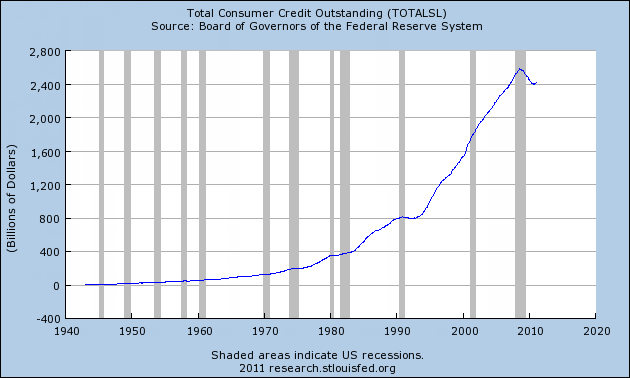
However, that does not negate the possibility of deflationary busts as the following chart shows.

Total Credit Market


Total Consumer Credit


The proper way of viewing inflation is via expansion and contraction of credit. The first chart shows that credit dwarfs money supply, regardless of what your measure of money is.

We have never before in history seen a credit bust of this magnitude, yet there is no good reason to think another bust cannot happen.

Indeed we just went through a deflationary bust, and there will be more, just as happened in Japan. All the current focus on prices is simply misguided. The fact that gasoline prices have soared pales in comparison to $trillions in debt wiped off the books in the housing bust. That is not conjecture subject to debate, but a simple logical fact, yet people tell me all the time we have inflation as measured by the price of eggs or gasoline or whatever.

Phooey, we have inflation now and have been in a state of inflation since Bernanke revived the corporate bond market in Spring of 2009. When the corporate bond market heads down again, the economy will once again feel the effects of deflation.

Inflation and Deflation Defined

My model defines inflation as a net expansion of money and credit with credit marked-to-market. Deflation is a net contraction of money and credit with credit marked-to-market.

The marked-to-market concept takes the market perception of credit into the picture. Debt that cannot be paid back won't, but if the market lets banks pretend that it will, the system still functions. Such is the state of affairs right now.

Hyperinflation Ends The Game

There are numerous misguided proponents of hyperinflation. Most do not understand that hyperinflation is a political event (the complete loss of faith in currency), not a measure if interest rates or price inflation.

A political event happens first (complete loss of faith of currency), and hyperinflation is the result. For a discussion please see Debating the Flat Earth Society about Hyperinflation

For a discussion about the nature of money and how much is needed, please see
Gold is Money, What About Silver? Can Gold be Debt?

The key issue regarding hyperinflation is that it is a political event and that it would destroy the banks and the Fed if it happened. In tat sense it benefits no one. The Fed would not want it to happen, nor would banks and the wealthy.

That does not make hyperinflation impossible, but given the political stability of the US, it sure makes it damn unlikely.

Hyperinflation Theory vs. Practice

This is what it comes down to: In theory, Congress can easily cause hyperinflation. In practice, they won't, and neither will the Fed. As Yogi Berra once quipped "In theory there is no difference between theory and practice. In practice, there is."

Does Government Benefit From Inflation?

Earlier I stated how government benefits from inflation (higher tax collections was one of the ways).

However, unlike banks and the wealthy who can and do invest money in assets, government squanders money.

Sure, government may collect more in taxes than before, but governments everywhere perpetually spend more than they take in. In practice, interest on the national debt and rising expenditures more than chew up any alleged "benefit" of inflation.

Thus it is an illusion that government benefits from inflation (depending of course on your definition of "government").

However, politicians prey on the illusion of benefit and also on the public's demand for government to "do something". In that sense, corrupt and ignorant politicians do benefit from inflation.

Summation

Hyperinflation ends the game and is unlikely.

Periodic bouts of deflation in conjunction with longer periods of inflation serves to concentrate wealth in the hands of bankers and other wealthy individuals.

In general, there are No "Miracle" Cures from Inflation. Rather, inflation slowly destroys the middle class over time for the benefit of banks and the wealthy who were not so foolish as to be over-leveraged in debt.

Mike "Mish" Shedlock
http://globaleconomicanalysis.blogspot.com
Click Here To Scroll Thru My Recent Post List